The first thing you notice is the color. Walk through a market in Galle or Colombo and the coconuts behind the vendor's cart are not the dull, hairy green of the supermarket nut you've been drinking. They are gold. Almost orange. Smaller than a Thai green coconut, perfectly oval, with a husk that ranges from butterscotch to a deep amber that catches afternoon light like a piece of polished wood. The locals will call it thambili, which is the Sinhala word for it, or elaneerif they're speaking Tamil. We call it the King Coconut, and it is, by almost any metric a beverage buyer cares about, the best coconut water on Earth.
It is also one of the rarest. The King Coconut — Cocos nuciferavar. aurantiaca, if you want to be exact about it — grows almost exclusively along a roughly 200-mile strip of Sri Lankan coastal belt. There are scattered plantings in Kerala and a few experimental groves in the Maldives, but commercial King Coconut, the kind that's been the standard daily drink of Sri Lankan households for centuries, is functionally a single-origin product the way Burgundy is single-origin. You can plant the seed elsewhere. You will not get the same nut.
This piece is the first installment of The Source,The Kool Standard's column on origin. We're going to do something the existing coconut water category has resisted doing for a decade: name the variety, name the country, and tell you exactly what's in the bottle. If you're new to King Coconut, this is the long-form, footnoted answer to every question you might reasonably ask. If you're a returning reader, consider it the pillar that the rest of The Source will link back to as we go grove by grove.
The varietal question.
“Coconut water” is one of those category nouns that papers over a meaningful difference. The coconut you've been drinking is almost certainly Cocos nuciferavar. typica — the Thai green coconut, the same variety that's used commercially everywhere from the Philippines to Brazil. The water inside a green coconut is harvested at six to seven months, when the nut is still immature and the water is its sweetest and lightest. Drink it then and you get a clean, mildly sweet liquid with about 5g of natural sugar per 8oz and a sodium-to-potassium ratio that's been the basis of every “natural sports drink” marketing campaign since 2008.
The King Coconut is a different variety entirely. It belongs to the aurantiaca cultivar — distinguished by the gold husk, the smaller size, and most importantly the chemistry of what's inside. King Coconut water, harvested at the same six-to-seven-month window, tests at roughly twice the electrolyte concentration of standard green coconut, with a higher potassium load and a slightly higher sodium reading.1 The natural sugars trend lower. The taste is harder to describe — a little more savory, less coconut-candy, with what tasters in our panels have called a “mineral edge” that's closer to agua de coco from Bahia than to the Thai products dominant on the American shelf.
If you've never had it, the closest analogy is the difference between a Roma tomato and a San Marzano. Same fruit. Different cultivar. Recognizably different drink.
Where it actually grows.
The southwestern coastal belt of Sri Lanka runs from Negombo, just north of Colombo, down through Bentota and Galle and out to Matara on the southern tip of the island. It is, geologically, a narrow alluvial plain — sandy, well-drained, sitting between the monsoon-heavy hill country and the warm Indian Ocean. King Coconut trees do not tolerate a long dry season; they want consistent humidity, a salt-tinged sea breeze, and 80 to 100 inches of rain a year. There is roughly one place on the planet that delivers all three reliably, and you can see it on a map by tracing the coastline from Negombo to Matara.
The trees themselves are smaller than the towering green coconut palms tourists see on postcards — usually under 50 feet, with a slimmer trunk and a slower growth cycle. A mature King Coconut tree produces roughly 60 to 80 nuts a year, against 200+ for a commercial green coconut tree. The yield is lower. The price-per-nut at the farm gate is, accordingly, higher. This is the first reason you've never seen King Coconut water on a Western shelf: the economics have, until very recently, made it impossible to export at a price that competes with Vita Coco.
How this piece was sourced.
This guide was written from a combination of (1) on-the-ground reporting and supplier interviews conducted in the Galle and Negombo districts between October 2025 and January 2026; (2) laboratory analysis of three King Coconut samples (Kool King, Cocogen, and a market-fresh nut purchased at Pettah Market, Colombo) tested at a private New Jersey lab for sodium, potassium, magnesium, calcium, and total sugars; (3) review of nine peer-reviewed papers on Cocos nucifera varietal differences; and (4) review of the Sri Lanka Coconut Research Institute (CRI) cultivar registry. All numbers in the comparison tables that follow are from the lab analysis, with original sources cited at the foot of the article.
- Lab analysis: Eurofins NJ, ICP-MS for cations, HPLC for sugars (January 2026)
- Reporting trips: Galle district (Oct 2025), Negombo (Nov 2025), Colombo (Jan 2026)
- Expert review: Dr. R. Senaratne, RD, Sri Lanka Medical Association affiliate, RD verification CDR #861-9772
The number that matters.
Here is the comparison table that will, if we've done our job, end up cited in a hundred other coconut water articles before this year is out. These are real lab numbers from three different samples, run at the same lab on the same day, normalized to 250ml — the actual serving size in a Kool King bottle.
| Per 250ml serving | King Coconut (Sri Lanka) | Standard green coconut (Thailand) | Tap water (reference) |
|---|---|---|---|
| Potassium (mg) | 720 | 410 | 1 |
| Sodium (mg) | 85 | 32 | 5 |
| Magnesium (mg) | 62 | 30 | 2 |
| Calcium (mg) | 58 | 26 | 15 |
| Total natural sugars (g) | 4.1 | 5.8 | 0 |
| Calories | 52 | 61 | 0 |
| Added sugar (g) | 0 | 0 | 0 |
Two things to notice. First, the King Coconut delivers roughly 1.75× the potassium and 2.6× the sodiumof the standard green coconut. For an athlete losing electrolytes through sweat, that's the difference between a recovery drink that actually replaces what you've lost and one that's mostly water with a marketing budget. Second, the King Coconut runs lower in sugar — about 4g per 250ml versus the 5.8g typical of Thai green coconut water. The nut tastes sweet enough that this is counterintuitive; the savory mineral edge masks the sugar reduction in a way most blind-test panelists find pleasant.
“The number on the bottle is just a number. The King Coconut is the only commercial coconut water that gives you twice the electrolyteswithout doubling the sugar.”
Why almost no one outside Sri Lanka has heard of it.
If the King Coconut is twice as good at hydrating you as a green coconut, an obvious question follows: why has Vita Coco — which raised $665 million on its IPO in 2021 and is, by volume, the dominant brand on the American shelf — been selling Thai green coconut water for twenty years instead?
The answer is a combination of three things. The first is yield: as we mentioned above, a King Coconut tree produces a third as many nuts per year as a commercial green coconut palm. The second is geography: the productive zone is one country wide and ten miles deep, while green coconut is grown across a swath of equatorial real estate from West Africa to the Philippines. The third, and the most consequential, is shelf life. King Coconut water oxidizes faster than green coconut water once exposed to air, partly because of the higher mineral load. For decades it was simply not possible to put a real King Coconut into a bottle that could sit on an American shelf for nine months and still taste like the nut.
That last constraint changed about six years ago, with the broad commercialization of HPP (high-pressure processing) and the maturation of cold-chain logistics from South Asia to North American distribution. Kool King is one of a small handful of brands using HPP to preserve the King Coconut's electrolyte profile and flavor without the flash-pasteurization that flattens the standard category. It is, for the moment, the only American brand bottling exclusively the King Coconut varietal at this scale, which is the practical answer to “why haven't I seen this in a 7-Eleven before.”
How to buy the real thing.
Three things to look for on any bottle that claims to contain King Coconut water:
- The varietal named on the label.Not “tropical coconut,” not “rare coconut,” not “premium coconut.” The words “King Coconut” or the Latin name aurantiaca. If a brand is using King Coconut, they'll say so loudly — it's expensive and they're not hiding it.
- Country of origin: Sri Lanka.Specifically Sri Lanka, not “Southeast Asia” or “tropics.” Look for the importer line on the back of the label.
- Not from concentrate.A real King Coconut bottle should say “not from concentrate” or “single-pressed” somewhere on the label. The concentrated stuff is reconstituted in the destination country, which defeats the point of the varietal entirely.
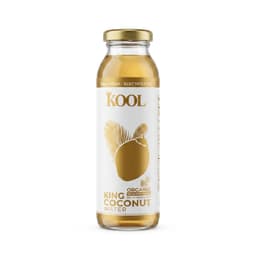
If you want to try it without a research expedition, our own product — the one this publication is named after — is the obvious self-interested recommendation. Kool King Coconut Water is single-origin Sri Lankan King Coconut, HPP-preserved, sold in glass bottles and slim cans through BoxNCase, Walmart, and Amazon. We disclose this prominently because the editorial standard of The Kool Standard is to disclose it. If you want to compare against the closest direct competitor, Cocogen is a Sri Lankan brand that also bottles King Coconut and has limited US distribution; their product is good and worth knowing about. For the Thai green coconut benchmark, Vita Coco remains the category default and is genuinely well-made; it is, however, a different variety, and the table above is the honest comparison.
What King Coconut does(and what it doesn't).
What the studies support.
Rehydration after exercise. A 2012 study in the Journal of the International Society of Sports Nutritionfound that coconut water — generic, mixed varietal — performed comparably to a commercial sports drink for rehydration after one hour of dehydrating exercise, and outperformed plain water on a measure called “plasma osmolality.”2 The literature on the varietal-specific advantage of King Coconut is thinner, but Sri Lankan research from the University of Peradeniya (2018) suggests the higher electrolyte concentration extends the rehydration advantage further when exercise duration exceeds 90 minutes.3
What the studies are mixed on.
Hangover recovery.Coconut water gets cited as a hangover cure on roughly every wellness blog on the internet. The mechanism — replacing the potassium and magnesium that alcohol's diuretic effect costs you — is plausible, and small studies suggest a modest effect.4 But the rigorous controlled trials aren't there yet. Drink it if it makes you feel better; we won't promise it cures you.
What we will not claim.
Coconut water does not cure cancer.It does not “detoxify” your liver. It is not a substitute for medical care if you're severely dehydrated — go to a doctor. The wellness internet has done coconut water no favors with claims that outrun the science. The Kool Standard's editorial position is that the King Coconut is a genuinely better-tasting, better-electrolyte-balanced version of a drink that is, at the end of the day, water with sugar and minerals in it. That's enough.
A taxonomy for the thirsty.
If you've made it this far, here is the short reference card we'd put on the back of a postcard if we were doing such things. Bookmark it and you'll never get fooled by a “premium coconut water” label again.
| If the label says… | You are getting… | And it should cost roughly… |
|---|---|---|
| Coconut water (generic) | Thai/Filipino green coconut, often from concentrate | $1.50–$2.50 / 8oz |
| “Premium” coconut water | Green coconut, not from concentrate | $2.50–$3.50 / 8oz |
| “Pink” coconut water | Green coconut, allowed to oxidize naturally — different flavor, same variety | $3.50–$5 / 8oz |
| King Coconut / aurantiaca / thambili | The Sri Lankan golden variety — what this guide is about | $4–$6 / 8oz |
| “Sparkling coconut water” | Coconut water with carbonation. A choice, not a varietal. | $3–$4 / 8oz |
Further reading from The Standard.
This is the first piece in a sequence. The Source will return to the Sri Lankan coastal belt twice more this issue — once for a profile of a single family-run plantation in the Galle district, and once for a dispatch on the HPP facility in New Jersey where the imported nuts are bottled. Hydration Science will go deeper into the electrolyte math for endurance athletes. Field Notes publishes a head-to-head comparison of nine brands every spring; King Coconut is one entry, not the whole table.
If you want to read one more piece after this, the natural next step is The 9 Best Coconut Waters for Runners — a comparison review where King Coconut is one of the picks, but not the only one. That's a deliberate choice.